
Investigation of Doping Effects and Defects in Chiral Carbon Nanotubes
Thaizy Carlos Nossa, Paulo José Pereira De Oliveira report the findings of this research. Carbon nanotubes are allotropes of carbon and are 1D nanomaterials with various applications, including their use as sensors, in composites, and even as drug delivery vectors. In t...
Cover Page

Advance Material Letters
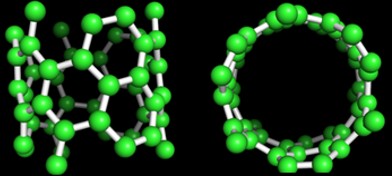
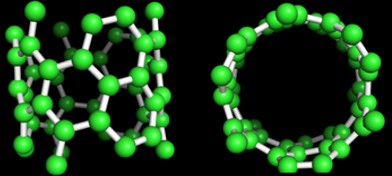
Carbon nanotubes are allotropes of carbon and are 1D nanomaterials with various applications, including their use as sensors, in composites, and even as drug delivery vectors. In this study, we employed density functional theory with a local density approximation, implemented in the SIESTA software, to analyze the electrical properties of the chiral (6,3) carbon nanotube containing 48 carbon atoms. We performed studies on energy bands and total and partial density of states. Systems doped with Boron and Nitrogen were investigated, as well as simulations of defects (vacancies). Our results indicate that the nanotube exhibits semiconducting behavior with a bandgap of 0.115 eV. However, after the inclusion of Nitrogen, Boron, and vacancy impurities
Browse issue 1 (Vol. 1)Featured Articles
Recent Articles
Investigation of Doping Effects and Defects in Chiral Carbon Nanotubes
Carbon nanotubes are allotropes of carbon and are 1D nanomaterials with various applications, including their use as sensors, in composites, and even as drug delivery vectors. In this study, we employed density functional theory with a local density approximation, implemented in the SIESTA software, to analyze the electrical properties of the chiral (6,3) carbon nanotube containing 48 carbon atoms. We performed studies on energy bands and total and partial density of states. Systems doped with Boron and Nitrogen were investigated, as well as simulations of defects (vacancies). Our results indicate that the nanotube exhibits semiconducting behavior with a bandgap of 0.115 eV. However, after the inclusion of Nitrogen, Boron, and vacancy impurities, its character changes to metallic, with energy bands crossing the Fermi level. The density of states analysis revealed that the carbon 2p orbitals contribute the most to charge mobility compared to the 2p orbitals of Boron and Nitrogen, and al
Dielectric Studies on Dendrite-shaped PbTe, Rod-shaped SnTe and their Nanocomposite
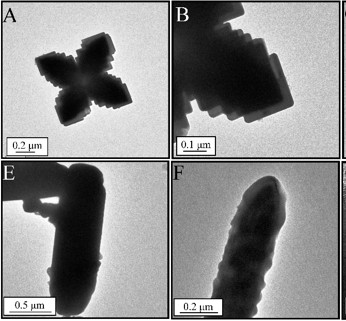
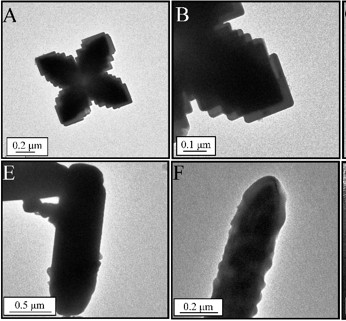
Dendrite shaped PbTe, SnTe nanorods and their nanocomposites were successfully synthesized via a simple hydrothermal method using hydrazine hydrate as a reducing agent. The formation of nanostructures was confirmed by high resolution transmission electron microscopy (HRTEM) in both the samples. A detailed study on dielectric properties of these samples in the frequency range of 50 Hz–50 MHz at various temperatures (50-100 C) shows a tremendous enhancement in PbTe and SnTe nanostructures compared to bulk. But in the case of composite system PbTe: SnTe have significantly lower dielectric constants than pure samples due to no additional percolation threshold in the system. Additionally, the potential mechanism behind the formation of dendrite-shaped PbTe is discussed. Raman spectroscopy further validated the presence of Sn within the PbTe system. The synthesized PbTe and SnTe nanostructures are capable of significantly enhancing the dielectric constant compared to their bulk counterparts
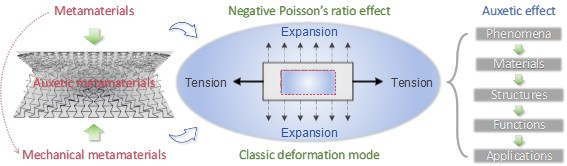
An Interesting Material: Auxetic Metamaterial
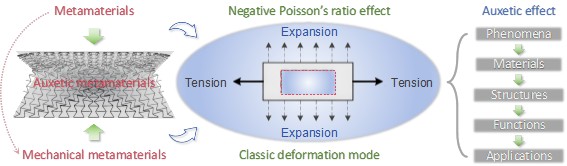
Metamaterials are a class of periodic or aperiodic artificial microstructures with unusual physical properties. Their unique and controllable properties provide rich design inspiration for human technology products. Negative Poisson’s ratio (NPR) metamaterial, also known as auxetic metamaterial, is a kind of mechanical metamaterial that can produce NPR effect different from common materials in nature, and has a long history of development and a wide range of application scenarios. This paper mainly reports the basic characteristics, development process and research content of auxetic metamaterial, and makes corresponding analysis and prospect, aiming to popularize its concept and explore its development potential in the field of mechanics. However, it should be noted that with the development of new technologies such as additive manufacturing and artificial intelligence, the future of auxetic metamaterial is still full of uncertainties. To this end, the design of new configurations, th
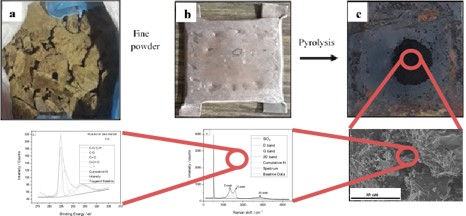
Facile Synthesis of Disordered Graphitic Charcoal by Direct Pyrolysis of Mustard Oil Cake and Sugarcane Bagasse
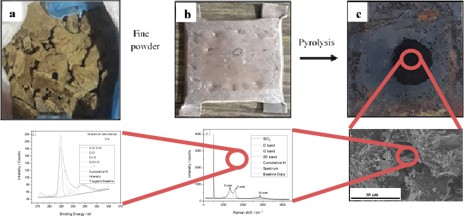
Charcoal was prepared in a facile way using a muffle furnace by direct pyrolysis of mustard oil cake and sugarcane bagasse attempting inert gas-free high-temperature pyrolysis at 900 °C. The structure of the obtained product was analyzed by Raman spectroscopy, X-ray photoelectron spectroscopy (XPS), scanning electron microscopy (SEM) and Fourier transform infrared (FTIR) spectroscopy. The lack of long-range order in the prepared charcoal has been attested by the appearance of weak and broad 2D peaks in the Raman spectra. The diameter of the crystallites was found to be 3.66 nm (mustard oil cake) and 3.79 nm (sugarcane bagasse). The material was found to consist essentially of amorphous carbon with the presence of oxygen-containing functional groups. On analyzing the elemental composition by XPS, only carbon and oxygen atoms were observed. The charcoal was found to retain the layered morphology, organized in a sheet-like or flakes-like manner, of precursor lignocellulosic biomass. Charc
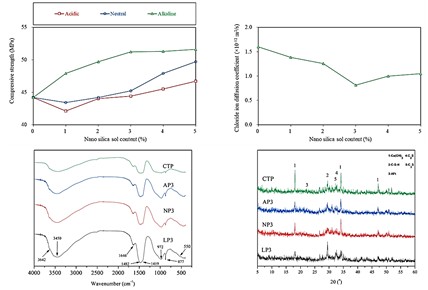
Use of Nano Silica Sol for Performance Improvement of Marine Cement-Based Mortar
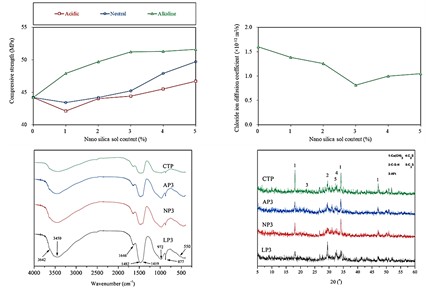
Nano silica sol is an aqueous solution containing colloidal nano-silica. From limited research in the literature, it has been reported to offer better effects on the cement-based materials compared with nano-silica powder, which is by far the most widely studied nano-material. In this research, the possible use of nano silica sol to improve the performance of marine cement-based mortar is investigated. The optimal type of nano silica sol among acidic, neutral, and alkaline pH is identified, followed by systematic experimentation of the flexural strength, compressive strength, chloride ion permeability, as well as Fourier-transform infrared (FTIR) spectrum and X-ray diffusion (XRD) pattern. It was found that alkaline nano silica sol outperformed acidic and neutral counterparts. Generally, the addition of nano silica sol increased the flexural and compressive strengths of marine mortar. Addition of 3% nano silica sol by volume of cement yielded remarkable effects, while further addition
