
Article Sections
Digital Light Processing (DLP) 3D Printing of Polyethylene Glycol (PEG) Biopolymer, Commercially available Ultra-High and Tough (UHT) Resin and Maghemite (γ-Fe2O3) Nanoparticles Mixture for Tissue Engineering Scaffold Application
Loading author information...
Graphical Abstract & Abstract
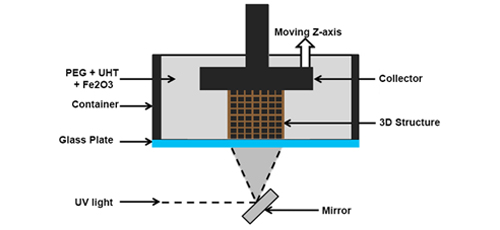
Digital Light Processing (DLP) 3D printing process has been used with standard, commercially available ultra-high and tough (UHT) photopolymer resin to produce for various 3D parts. Polyethylene glycol (PEG) biopolymer has been used extensively in biomedicine due to its excellent performance in biocompatibility and hydrophilicity. However, it offers low mechanical strength. The inclusion of maghemite (γ-Fe2O3) nanoparticles have been found to be able to increase the mechanical properties of TE scaffolds fabricated using a combination of processes. This study aims at exploring the possibility of using various mixtures which consists of different combinations UHT resin, PEG solution and γ-Fe2O3 nanoparticles with the DLP 3D printer system. The effects of various quantities of mixtures were investigated in terms of their mechanical and biocompatibility properties with a view of producing TE scaffolds. The results from this study proves that the simpler, DLP 3D printer system can be used w
How to Cite
(2019). Digital Light Processing (DLP) 3D Printing of Polyethylene Glycol (PEG) Biopolymer, Commercially available Ultra-High and Tough (UHT) Resin and Maghemite (γ-Fe2O3) Nanoparticles Mixture for Tissue Engineering Scaffold Application. Advanced Materials Letters, 10(11), 802-806. https://doi.org/10.5185/amlett.2019.0023