
Article Sections
Ring models of atoms, molecules and nanomaterials
Loading author information...
Graphical Abstract & Abstract
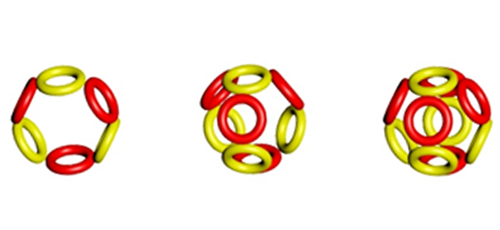
The classical approach in particle physics is based on the fact that the electron has some parameters like charge, mass, etc. but does not have a structure. In our calculations, the electron is assumed as structured particle having magnetic properties. VFRT (Vortex Fractal Ring Theory) uses the electron, proton, and neutron as a particle with a toroidal (ring) shape, which is formed by fractal substructures connected to each other by vortex electromagnetic fields. The atomic nucleus can be built from the ring protons and neutrons. Combining knowledge of physical chemistry, evolutionary optimization, 3D graphic, programming in Python, and mathematics makes it possible to create programs for designing new nanostructure models. The first testing proposal for the nanostructure prediction program is limited to carbon structures. The aim was to verify whether the proposed program is capable of generating known carbon nanostructures, such as graphene. The following versions of the program wil
Keywords
How to Cite
(2019). Ring models of atoms, molecules and nanomaterials. Advanced Materials Letters, 10(4), 248-252. https://doi.org/10.5185/amlett.2019.2223