
Article Sections
Bi-doped CH3NH3PbI3 effective masses and electronic properties research: A theoretical study using VASP
Loading author information...
Graphical Abstract & Abstract
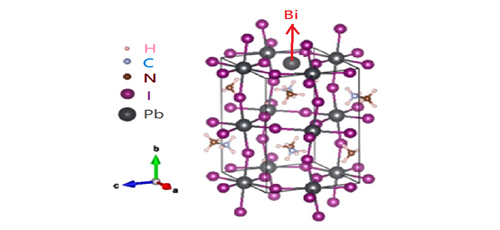
We calculated the effective masses and electronic properties of Bi-doped CH3NH3PbI3 perovskites as a thermoelectric material using the VASP functional. The Bismuth doping concentration of 11.1%, 20%, 33.3% corresponding band gaps are 1.46. 0.75, 0.56 eV, respectively. The effective masses of carriers and the band gaps decrease with the doping concentration addition. We found that the structure of Bi as an interstitial atom doped MAPbI3 were much more stable than undoped one by the crystal systemic energy, and the Bi doping made the Fermi Level shift close to the bottom of conduction band, leading to charge carrier close to the Fermi level, resulted in the higher electrical conductivity. Moreover, Bi doping produced a smaller electron effective mass with doping concentration addition, increasing the MAPbI3’s mobility. As a result, the Bi-doped MAPbI3 could simultaneously enhance the electrical conductivity and Seebeck coefficient. Our results showed that Bi doped MAPbI3 is a promising a
How to Cite
(2019). Bi-doped CH3NH3PbI3 effective masses and electronic properties research: A theoretical study using VASP. Advanced Materials Letters, 10(4), 275-278. https://doi.org/10.5185/amlett.2019.2232