
Article Sections
Various surfactants for 0 – 3 dimensional nanocarbons: Separation, exfoliation and solubilization
Loading author information...
Graphical Abstract & Abstract
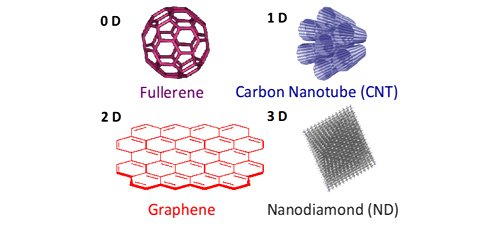
Nanocarbons are carbon allotropes with nanometer scale and comprised mainly of 0 – 3 dimensional (0D – 3D) forms; fullerenes (0D), carbon nanotubes (1D), graphene (2D), and nanodiamond (3D). In our group, various surfactants with appropriate size and shape have been developed for the nanocarbons. In order to separate the fullerenes, bowl-shaped surfactants were designed and synthesized to accommodate the 0D spherical nanocarbon, giving C70 selectively as precipitates. On the other hand, gable- and bracket-shaped surfactants formed stable complexes with 1D tubular nanocarbons, dispersing carbon nanotubes with specific diameter, handedness and/or metallicity selectively in solution phase. The flat surfactants worked as an exfoliant and dispersant for graphite in both wet and dry processes; sonication and ball milling, respectively. They gave graphene composites with high concentrations and yield in aqueous solution and low-boiling point organic solvents. The hyper-branched polymer named
How to Cite
(2019). Various surfactants for 0 – 3 dimensional nanocarbons: Separation, exfoliation and solubilization. Advanced Materials Letters, 10(8), 520-523. https://doi.org/10.5185/amlett.2019.2278