
Article Sections
Matrix and Variant Transformations Simulate Statistical Canonical Ensembles from Fock to Poissonian States of Random Sequences
Loading author information...
Graphical Abstract & Abstract
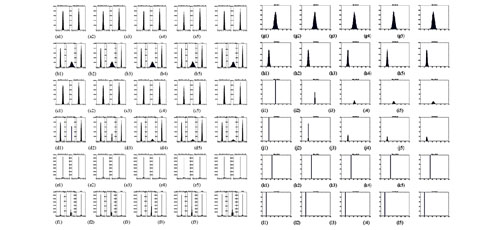
From a quantum statistical viewpoint, four typical quantum states are Fock, Sub-Poissonian, Poissonian and Super-Poissonian states. Quantum interactions are among Fock and Poissonian states. Using quantum statistics, model and simulation, this paper propose two models: matrix and variant transformations: 1. MT Matrix Transformation – eigenvalue states; 2. VT Variant Transformation – invariant states to analyze three random sequences: 1) random; 2) conditional random in a constant; 3) periodic pattern. Four procedures are proposed. Fast Fourier Transformation FFT is applied as one of MT schemes and two invariant scheme of VT schemes are applied, three random sequences are used in M segments, and each segment has a length m to generate a measuring sequence. Shifting operations are applied on each random sequence to create m+1 spectrum distributions. Better than FFT, VT can identify Fock, Sub-Poissonian, Poissonian states in random analysis to distinguish three random sequences as three
How to Cite
(2019). Matrix and Variant Transformations Simulate Statistical Canonical Ensembles from Fock to Poissonian States of Random Sequences. Advanced Materials Letters, 10(9), 622-626. https://doi.org/10.5185/amlett.2019.9911