
Article Sections
Molecular Dynamics and FEM Modeling of Composites Having High Thermal Conductivity
Loading author information...
Graphical Abstract & Abstract
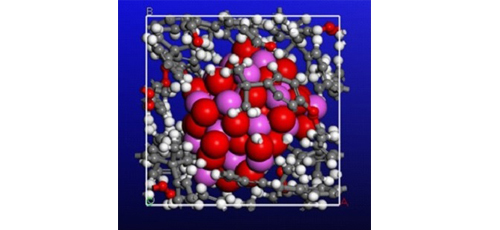
Nowadays there is a requirement of material that has high thermal conductivity as well as suitable electric insulating properties. Such materials are required in industries where thermal management is desirable but electrical conductivity is not required, such as substrates for electronic components and solar panels. In this study, the multi-scale modeling of epoxy (bisphenol-A) reinforced alumina composite has been performed using BIOVIA Materials Studio and Abaqus. Modeling has been done for varying volume fraction (Vf) of alumina. The properties predicted are the thermal conductivity and Young’s modulus. Heat transfer analysis has been done using Abaqus/Explicit. It was found that the thermal conductivity first increased till Vf = 20% and then decreased. When the concentration of alumina was increased further after Vf = 20%, the orientation of alumina particles changed from being in-plane to random, resulting in a fall in the values of thermal conductivity. In the silicon/insulato
How to Cite
(2020). Molecular Dynamics and FEM Modeling of Composites Having High Thermal Conductivity. Advanced Materials Letters, 11(9), 1-7. https://doi.org/10.5185/amlett.2020.091557