
Article Sections
A review on humidification membrane materials for fuel cells
Loading author information...
Graphical Abstract & Abstract
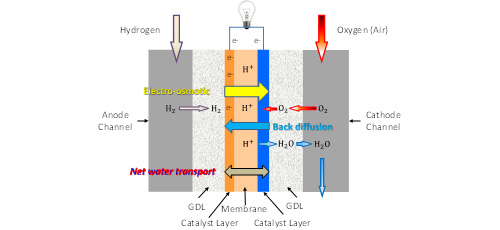
Polymer electrolyte membrane (PEM) fuel cells have the potential to replace fossil fuel sources in both automotive and auxiliary stationary power generation applications. Increased implementation of fuel cells would decrease dependence on oil and reduce greenhouse gas emissions. However, a major obstacle preventing widespread adoption of fuel cells is cost. The two largest contributors to fuel cell costs are platinum catalyst loading and fuel cell power density. The general strategy for increasing power density and decreasing costly catalyst loading remains unchanged regardless of the catalyst used, i.e., to run the fuel cell at higher temperatures and pressures. Present-day automotive fuel cells typically operate over a temperature range of 50-90°C and pressures up to 3 atm. Increasing temperature and pressure allows for reduced catalyst loading and higher voltage output from the fuel cell. These harsher operating conditions require new membrane materials for thermal and water managem
How to Cite
(2018). A review on humidification membrane materials for fuel cells. Advanced Materials Letters, 9(4), 225-233. https://doi.org/10.5185/amlett.2018.1886