
Article Sections
Mechanical properties of hydroxyapatite scaffolds produced by gel-casting and combination gel-casting/polymer foams infiltration
Loading author information...
Graphical Abstract & Abstract
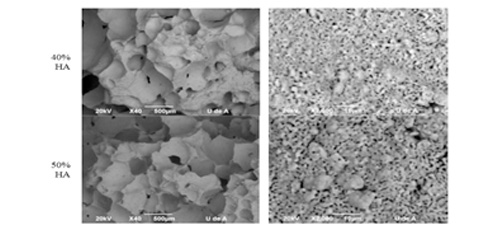
Hydroxyapatite is one of the appropriate materials for hard tissue engineering because it is the inorganic structural constituent of bones and teeth, and hydroxyapatite has been evaluated to compare the mechanical properties, processing as scaffolds to evaluate the influence of porosity, since the elastic modulus of material is influenced by the porosity, it is essential to establish a relationship between the two characteristics to obtain a material with optimum conditions for its implantation. The main objective of this research was to study the mechanical properties of hydroxyapatite scaffolds using compression and nanoindentation tests. The scaffolds were manufactured by gel-casting and gel-casting combined with foam polymer infiltration, in both cases 40 and 50% solids and three different monomers were used. The samples obtained by gel-casting exhibited a compressive strength between 0.93 and 6.15 MPa, an elastic modulus between 11.46 and 27.27 GPa; some of these scaffolds showed
How to Cite
(2018). Mechanical properties of hydroxyapatite scaffolds produced by gel-casting and combination gel-casting/polymer foams infiltration. Advanced Materials Letters, 9(4), 266-274. https://doi.org/10.5185/amlett.2018.1981