
Article Sections
Synthesis and modelling of nanoparticles for chemical looping reforming
Loading author information...
Graphical Abstract & Abstract
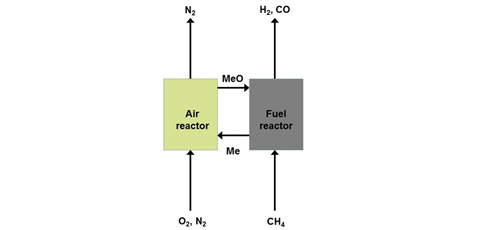
Experimental and complementary modelling studies on the potential use of iron oxide nanoparticles in chemical looping reforming processes have been performed. In order to avoid coarsening of the nanoparticles, and thereby loss of reactivity, at relevant process temperatures (700-900°C), the active metal oxide was embedded in an inert support material of lanthanum silicate. Micro reactor tests indicate that partial combustion occurs in reactions of reduced iron oxide with methane instead of pure reforming. Density Functional Theory and kinetic Monte Carlo calculations have been used to support and complement the experiments. The modelling supports efficient reactivity towards exposure of hydrogen, which is also observed experimentally. Reactivity towards methane is only tested for the fully oxidized state, Fe2O3, and not for the reduced oxide, giving results that are complementary to the experiments. Copyright © 2018 VBRI Press.
How to Cite
(2018). Synthesis and modelling of nanoparticles for chemical looping reforming. Advanced Materials Letters, 9(6), 439-443. https://doi.org/10.5185/amlett.2018.1929