
Article Sections
Collection and Characterization of Synthetic Airborne Particles
Loading author information...
Graphical Abstract & Abstract
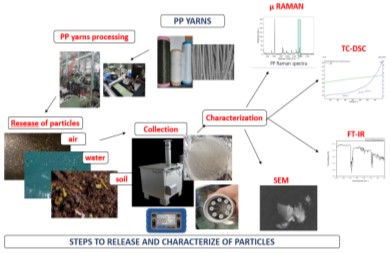
This paper presents the polypropylene (PP) micro-nano particles (MNPs) exposure routes of textile industry personnel and analyses the characteristics of such particles collected in and outside the workplaces. A Laser Aerosol Spectrometer set was used to determine: the total suspended particles (TSP), PM10, PM2.5, PM1 fractions (µm/m3), and the total number of particles (TC) (1/l) from the air. Specific methods for descriptive statistics were used to characterize the particle populations. Mean, dispersion and standard deviation, median and quartiles, skewness and kurtosis for asymmetry, and highlighting the cases in which they should be performed were calculated. The box plots and histograms graphs for TSP, PM10, PM2.5, and PM1, TC variables. The comparative analysis of the results led to the identification of the fraction of the particles with the highest value concentration in the air. The particles were collected on quartz and polycarbonate filters with gold membrane using TECORA and
Keywords
How to Cite
(2023). Collection and Characterization of Synthetic Airborne Particles. Advanced Materials Letters, 14(1), 1-12. https://doi.org/10.5185/amlett.2023.011714