
Article Sections
The Structural Influence of Airborne Particles on their Toxicity
Loading author information...
Graphical Abstract & Abstract
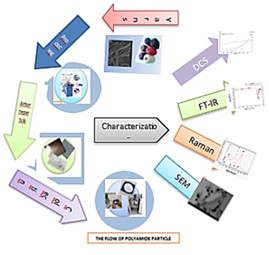
This paper studies human exposure to microplastics in real-life situations. The concentration of the polyamide nano/microplastics in the proximity of textile workplaces was made by the device Laser Aerosol Spectrometer. The descriptive statistical analysis was elaborated for: variables TSC (total concentration µg/m3), PM10 (µg/m3), PM2.5 (µg/m3), PM1 (µg/m3) and TC (total number of particles, 1/l). The histograms of each variable highlight the asymmetry of the distribution, with the predominance of frequencies or variables; representation of level indicators (average, median) and dispersion-box-plot graphs were obtained. Collection of the particle made with TECORA-SKYPORT PM-HV and GilAirPlus pumps, by using Quartz and Nucleopore filters with different diameters highlighted that the highest mass (683µg) was collected by using GilAir Plus pump and Quartz filter 37mm. A strong correlation was obtained between the variable: "Collected mass/ Air concentration": r = 0997775 ÷ 0,999477 and "
How to Cite
(2023). The Structural Influence of Airborne Particles on their Toxicity. Advanced Materials Letters, 14(2), 2302-1718. https://doi.org/10.5185/amlett.2023.021718