
Article Sections
Comparative Study of the Photothermal Behavior of Polydopamine-, Polypyrrole-, and Carbon Nanotubes-based Materials
Loading author information...
Graphical Abstract & Abstract
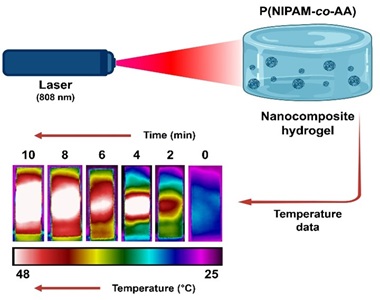
The development of conjugated polymer- and carbonaceous-based platforms as NIR photothermal materials is a valuable contribution to modern-day cancer therapies. Measurements of the thermal response of these materials under same NIR irradiation conditions allows accurately comparing their photothermal capacities to accomplish specific biomedical requirements. In this work, polydopamine (PDA) and polypyrrole (PPy) nanoparticles were synthesized by green-based methods and their photothermal behavior, compared to that of acid-treated carbon nanotubes (CNT), was studied under the same experimental setup. Furthermore, PDA, PPy, and CNT nanostructures were embedded within a crosslinked poly(N-isopropylacrylamide-co-acrylic acid) (P(NIPAM-co-AA)) matrix, and the photothermal properties of these novel nanocomposite hydrogels were also comparatively studied. Experimental conditions such as the filler concentration, irradiation time, and laser power, as well as the nanocomposite
How to Cite
(2024). Comparative Study of the Photothermal Behavior of Polydopamine-, Polypyrrole-, and Carbon Nanotubes-based Materials. Advanced Materials Letters, 15(2), 2402-1750. https://doi.org/10.5185/amlett.2024.021750