
Article Sections
Influence of CNT Concentrations on Structural and Morphological Properties of PANI-SnO2-CNT Nanocomposite Thin Films and the Sensitivity Performance to Detect E. coli in Water
Loading author information...
Graphical Abstract & Abstract
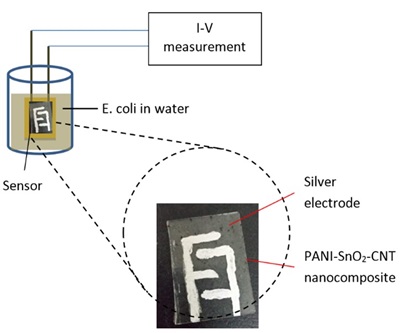
Carbon nanotubes (CNTs) are particularly attractive for use in sensors for environmental and health monitoring. This study proposes a new approach in developing polymer-metal-based sensor for E. coli detection by using CNTs incorporation. PANI-SnO2 nanocomposite thin films were combined with CNTs to be fabricated as biosensing devices. PANI-(SnO2)1-x-CNTx nanocomposite thin films were synthesized using sol-gel method and deposited on a glass substrate by spin coating technique. The prepared thin films were characterized by X-ray diffraction (XRD), field scanning electron microscopy (FESEM), atomic field microscopy (AFM) and ultraviolet-visible (UV-vis) spectroscopy. The sensitivity performance of PANI-(SnO2)1-x-CNTx nanocomposite thin films were conducted by using current-voltage (I-V) measurements. From the results, XRD patterns show the appearance of PANI
Keywords
How to Cite
(2024). Influence of CNT Concentrations on Structural and Morphological Properties of PANI-SnO2-CNT Nanocomposite Thin Films and the Sensitivity Performance to Detect E. coli in Water. Advanced Materials Letters, 15(3), 2403-1757. https://doi.org/10.5185/amlett.2024.031757