
Article Sections
Optimizing Titanium-dioxide Photocatalysts for Efficient Degradation of Methylene Blue: The Influence of Hydrothermal Reaction Time
Loading author information...
Graphical Abstract & Abstract
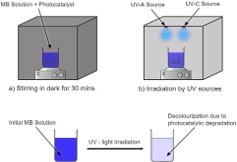
This research explores the influence of hydrothermal reaction time on the structural, optical and morphological properties of TiO2 nanoparticles. The photocatalytic performance of TiO2 nanoparticles for the degradation of Methylene Blue is also evaluated and a co-relation between reaction time and photocatalytic efficiency is established. Structural analysis reveals well-defined anatase phases with enhanced crystallinity at extended reaction times. UV-Visible spectroscopy demonstrates a red shift in absorption with increased reaction time, indicative of tuneable optical properties. FE-SEM images show an increase in particle agglomeration with increasing hydrothermal duration. Photocatalytic experiments underline TiO2-12 as the most efficient catalyst, achieving a remarkable 97% degradation within 105 minutes. The Langmuir-Hinshelwood kinetics model elucidates the reaction rate dependence on hydrothermal reaction time, emphasizing the role of synthesis parameters on the photocatalytic a
How to Cite
(2024). Optimizing Titanium-dioxide Photocatalysts for Efficient Degradation of Methylene Blue: The Influence of Hydrothermal Reaction Time. Advanced Materials Letters, 15(4), 2404-1763. https://doi.org/10.5185/amlett.2024.041763