
Article Sections
Electrochemical promotion of ammonia synthesis with proton-conducting solid oxide fuel cells
Loading author information...
Graphical Abstract & Abstract
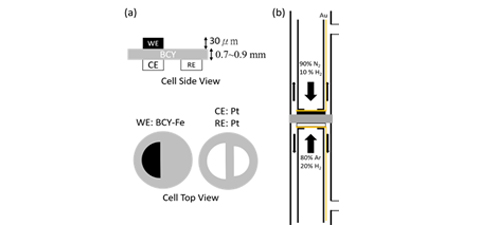
Direct electrochemical synthesis of ammonia was performed using proton-conducting solid oxide fuel cells. In this study, we investigated the effect of electrode potential on the reaction kinetics of ammonia formation with Fe- and Ru-based catalysts in detail. The cell configuration was Pt|BaCe0.9Y0.1O3 (BCY)|K-modified Fe or Ru-BCY. The ammonia formation rate of K-Ru was higher than that of K-Fe at the rest potential. However, the ammonia formation rate significantly increased by cathodic polarization for the Fe catalyst, and it showed a linear increase for the Ru catalyst, i.e., the ammonia formation rate for K-Fe significantly increased from the rest potential by several hundred times to -1.2V at 700 o C, but K-Ru showed only a five times increase. The results suggest that the addition of K into Fe-BCY and cathodic polarization can improve the ammonia formation rate because of the promotion of bond dissociation of the N molecule on the Fe catalyst. The present work provides a hint fo
How to Cite
(2019). Electrochemical promotion of ammonia synthesis with proton-conducting solid oxide fuel cells. Advanced Materials Letters, 10(8), 563-568. https://doi.org/10.5185/amlett.2019.2259