
Article Sections
Characterization of the Interfacial Surface Energy for Composite Electrical Conduction Measurements using Two Full Range Percolation Threshold Models
Loading author information...
Graphical Abstract & Abstract
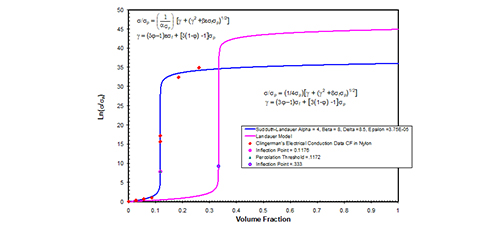
Two full concentration range percolation threshold models were evaluated for three different carbon fillers in both Nylon 6,6 and Lexan. A new Modified Landauer Model was introduced in this study and compared with a Percolation Threshold Model recently published by this author. These models were then utilized to address how to best characterize the interfacial surface energy, gpf, for composite electrical conduction measurements using Clingerman’s data. Three different models used for calculating the interfacial surface energies, gpf, were evaluated in this study. It was found that solid measurements used in calculating the Fowkes equation for the interfacial surface energy gave the most consistent correlations. A linear correlation was found between the Fowkes Interfacial surface energy and the b constant designated as the insulation surface interaction magnitude from the new Percolation Threshold Model. In addition, three concurrent mathematical conditions were found to occur at the
Keywords
How to Cite
(2020). Characterization of the Interfacial Surface Energy for Composite Electrical Conduction Measurements using Two Full Range Percolation Threshold Models. Advanced Materials Letters, 11(3), 1-12. https://doi.org/10.5185/amlett.2020.031484