
Article Sections
Highly sensitive hydrogen gas sensor based on Al-doped SnO2/Polyaniline composite nanofibers
Loading author information...
Graphical Abstract & Abstract
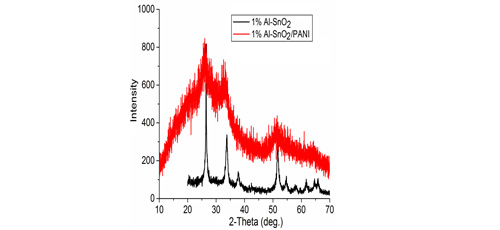
Metal oxide nanofibers showed keen interest in chemical gas sensing due to their unique chemical and electrical properties at operating temperature more than 200 o C. Their sensitivity can be improved at low operating temperature closed to room temperature by using conducting polymers. In this paper, Al doped tin oxide/polyaniline composite nanofibers detected H2 molecules at room temperature. A simple versatile electrospinning technique is used for the fabrication of Aluminium (Al) doped (tin oxide) SnO2 nanofibers and polyaniline was encapsulated using chemical oxidative polymerization (COP) of aniline monomer using ammonium persulfate as redox initiator. The structure and morphology of Al-doped SnO2/PANI composite nanofibers were investigated by SEM-EDX, UV-VIS and XRD spectroscopy. Structural changes of SnO2/PANI crystal due to the incorporation of Al 3+ ions have been explained. Al-doped SnO2/PANI composite nanofiber is very much selective towards H2 gas molecules in terms of high
How to Cite
(2018). Highly sensitive hydrogen gas sensor based on Al-doped SnO2/Polyaniline composite nanofibers. Advanced Materials Letters, 9(3), 182-187. https://doi.org/10.5185/amlett.2018.1591