
Article Sections
Recent Advances in Poly(3-Hydroxybutyrate-co-3-Hydroxyvalerate) Biocomposites in Sustainable Packaging Applications
Loading author information...
Graphical Abstract & Abstract
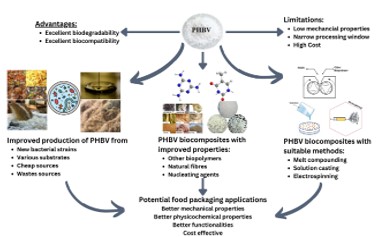
Poly(3-hydroxybutyrate-co-3-hydroxyvalerate) (PHBV) is the most promising and appropriate microbial biopolymer as a replacement for conventional petroleum-based non-biodegradable polymers, due to its excellent biodegradability and biocompatibility. However, it has a few limitations that prevent it from being used commercially, including low mechanical strength, hydrophobicity, poor thermal and electrical properties, difficult processing, and high cost. Recent researches has shown that it is the most promising natural biopolymer, particularly for packaging. To use PHBV in biocomposites, methods of compensating for PHBV's shortcomings, such as adding fillers, more cost-effective and efficient production methods, or alternative PHBV sources, must be developed. Numerous researchers are looking into ways to improve characteristics and lower prices by developing biocomposites to address environmental safety concerns with PHBV, developing and discovering more affordable biological PHBV produc
Keywords
How to Cite
(2024). Recent Advances in Poly(3-Hydroxybutyrate-co-3-Hydroxyvalerate) Biocomposites in Sustainable Packaging Applications. Advanced Materials Letters, 15(1), 2401-1739. https://doi.org/10.5185/amlett.2024.011739