
Article Sections
PRAP-CVD: Up-scalable process for the deposition of PEDOT thin films
Loading author information...
Graphical Abstract & Abstract
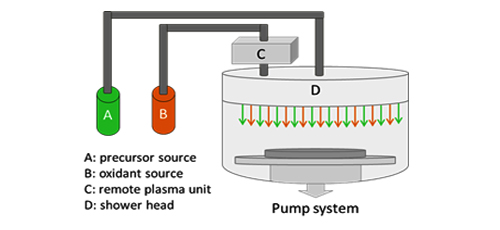
Plasma radicals assisted polymerization via CVD (PRAP-CVD) is emerging as an efficient alternative to conventional vapour based techniques to synthesise and deposit conjugated polymers. PRAP-CVD process is based on the concomitant but physically separated injection of low-energy oxidative radical initiators and vaporized monomer species into a reactor where temperature and pressure are finely controlled. Gas phase oxidative radicals are generated by a remote plasma chamber from a pure or diluted initiator. The low deposition temperature, below 100 °C, allows polymers to be directly synthesised on a wide range of substrates, including fabric, paper and plastic, without any thermal degradation and keeping a high degree of surface conformality. Additionally, the PRAP-CVD does not require post-deposition rinsing procedure which allows a wider range of application. PRAP-CVD PEDOT depositions have been carried out on different substrates with a transparency higher than 80% in the visible ran
How to Cite
(2019). PRAP-CVD: Up-scalable process for the deposition of PEDOT thin films. Advanced Materials Letters, 10(3), 201-205. https://doi.org/10.5185/amlett.2019.2186