
Article Sections
Solar Cell Characteristic Studies on Metal Organic Framework/TiO2 Hybrid Solar Cell
Loading author information...
Graphical Abstract & Abstract
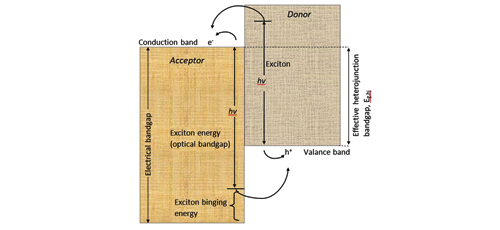
1,3,5-Triazine-2,4,6-trithiolate (TCA) coordination polymer and TiO2 metal oxide were used to prepare a hybrid solar cell. Electrochemical polymerization of TCA on copper electrode forms CuTCA metal-organic framework (MOF). The CuTCA acts as optically active and hole transport layer whereas TiO2 acts as exciton dissociation surface. The device was characterized under 100 mW/cm 2 condition in Cu/CuTCA-MOF/TiO2/Ag geometry, where copper and silver serve as bottom and top electrodes respectively. The device yield power conversion efficiency (PCE) of 0.196 with open-circuit voltage (Voc), short circuit current (Isc) as 0.161 V and 0.431 mA/cm 2 respectively. The room temperature electrical characterization of CuTCA-MOF reveals its hole mobility (µ), thermally generated hole concentration (no) and resistance as 10.16x10 -3 m 2 /Vs, 8.27x10 18 m -3 and 250 Ω respectively.
Keywords
How to Cite
(2020). Solar Cell Characteristic Studies on Metal Organic Framework/TiO2 Hybrid Solar Cell. Advanced Materials Letters, 11(9), 1-5. https://doi.org/10.5185/amlett.2020.091555